
WELCOME BONUS 300%
UP TO €2000 + 100
FREE SPINS
UP TO €2000 + 100
FREE SPINS
Home → Blackjack
Blackjack at Harry Casino: Variants, Rules and Payouts
Six Decks to Eight Decks in the Shoe
Infinite Blackjack uses six decks, resulting in a house edge of 0.46 percent when standard rules apply. This configuration is slightly less favorable than single-deck variants, which offer a lower edge of 0.15 percent due to reduced card removal effects. Players must adjust their basic strategy accordingly to minimize long-term losses on this specific table.
Quantum Blackjack Plus Live also employs six decks but incorporates quantum multipliers up to 1,000x for three-card combinations totaling twenty-one points. This feature increases volatility significantly compared to standard games, as payouts can jump dramatically based on random number generation outcomes. The theoretical return remains high at 99.57 percent under optimal play conditions despite the added variance.
Standard six-deck blackjack without special features typically carries a house edge of 0.46 percent if the dealer stands on soft seventeen. Switching to eight decks increases this edge by approximately 0.02 percentage points, making the game marginally more expensive over time. Understanding these subtle differences helps players choose tables that align with their bankroll management strategies effectively.
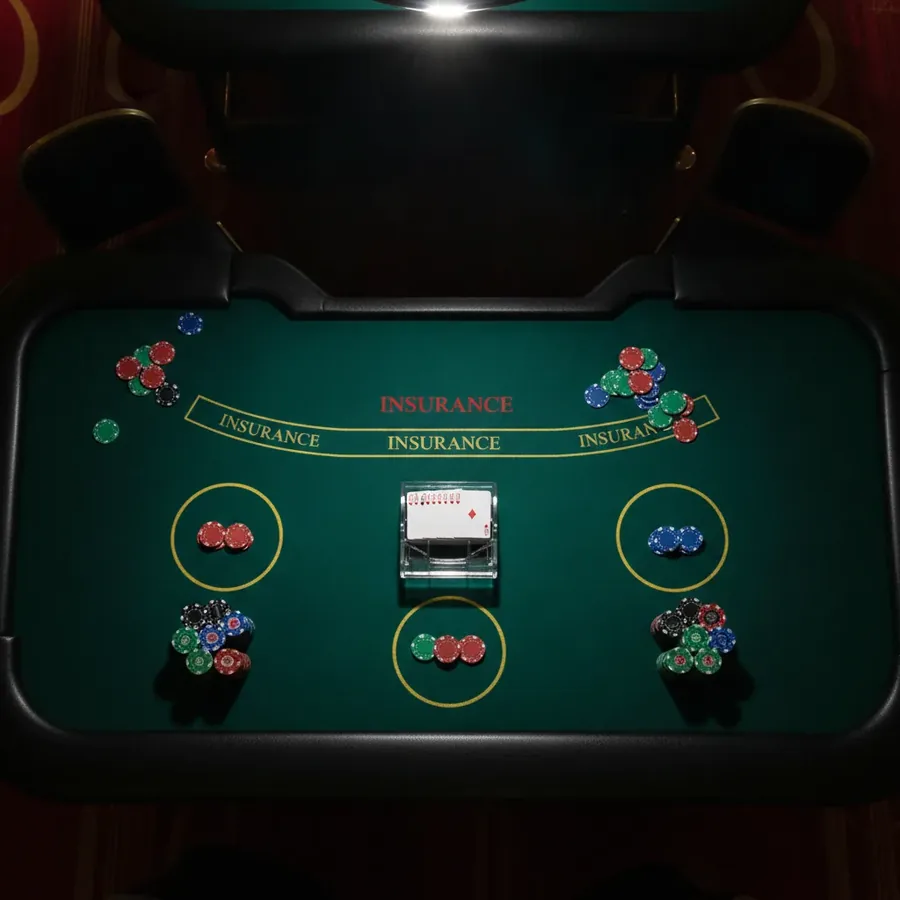
Error insurance: 7 percent additional house edge
The Blackjack Insurance side bet offers a payout ratio of 2 to 1 when the dealer shows an Ace. This specific wager carries a house edge of 7.47 percent, which is significantly higher than the main game's baseline. The return to player for this option drops to 92.53 percent, indicating substantial long-term losses for participants who rely on it.
Basis strategy dictates that players must always reject this insurance offer unless they are counting cards with a true count of plus three or higher. For a standard single-deck game, the house advantage stands at approximately 5.88 percent without the card-counting exception. Taking insurance without a positive count mathematically guarantees a slower rate of bankroll depletion over thousands of hands.
This side bet allows wagers up to 50 percent of the original main stake, increasing exposure during unfavorable conditions. Since the separate hedge costs more than the potential protection provides, it erodes the overall expected value of the session. Players seeking optimal payout speed should avoid this trap entirely to preserve their capital for winning rounds.
One Deck vs Eight Decks in House Edge
A single-deck blackjack variant with classic rules and a 3 to 2 payout delivers a house edge of only 0.15 percent. This configuration achieves an impressive RTP of 99.85 percent, making it one of the most favorable tables available for skilled players. The reduced number of cards lowers the casino's statistical advantage compared to multi-deck shoe games.
Playing with eight decks typically increases the house edge by roughly 0.48 percentage points relative to the single-deck version. However, many casinos compensate for this disadvantage by altering other rules, such as changing the blackjack payout from 3 to 2 down to 6 to 5. This specific rule change adds exactly 1.39 percentage points to the house edge, overwhelming the benefit of fewer decks.
At a $10 bet, a natural blackjack pays $12 under the 6 to 5 rule instead of the standard $15. This reduction in immediate returns significantly impacts the effective payout speed and overall profitability for the player. Choosing the correct deck count and payout structure is essential for minimizing the financial loss per hour of play.
The variance between these two formats affects how quickly a player can recover losses or grow their balance. Single-deck games require stricter adherence to basic strategy to maintain the low 0.15 percent edge. Multi-deck shoes often introduce additional rule modifications that further tilt the mathematical probability against the participant.
Infinite Blackjack uses the Six Card Charlie
Infinite Blackjack by Evolution features a unique rule known as the Six Card Charlie, which automatically wins if the player draws six cards without busting. This table accommodates unlimited players at once, allowing everyone to act simultaneously without waiting for others to finish their turns. The minimum stake starts at 1 EUR while the maximum limit reaches 5,000 EUR per hand.
The game maintains a strong RTP of 99.47 percent when players employ optimal strategic decisions throughout every round. Four distinct side bets are available, including Any Pair, 21 Plus Three, Hot 3, and Bust It, each offering different risk profiles. These options provide alternative ways to engage with the game beyond the primary objective of beating the dealer.
The Six Card Charlie rule effectively reduces the house edge by rewarding persistence in drawing cards rather than standing early. This mechanic encourages longer sessions and alters the traditional calculation of bust probabilities for players holding weak totals. Consequently, the payout frequency may feel higher compared to standard blackjack variants with rigid standing rules.
Card Counting at Shuffle Master Table: why it fails
Quantum Blackjack Plus Live by Playtech utilizes continuous shuffling mechanisms that render traditional card counting strategies completely ineffective. The system constantly reshuffles cards after every hand, ensuring that the composition of the remaining deck never shifts enough to provide a predictive advantage. Players cannot track high or low cards because the deck resets before any meaningful pattern emerges.
This live table offers stakes ranging from 1 to 5,000 EUR with quantum multipliers reaching up to 1,000 times on specific three-card combinations totaling 21 points. The RTP sits at 99.57 percent under optimal strategy, but this figure assumes random distribution rather than skill-based prediction. The technology eliminates the possibility of gaining a mathematical edge through observation alone.
Traditional counters rely on predicting favorable decks, but the automatic shuffle destroys the correlation between previous outcomes and future deals. Even if a player identifies a temporary imbalance, the next shuffle erases any accumulated advantage immediately. This design ensures that the house edge remains constant regardless of player behavior or experience level.
The presence of side bets like Hot 3 introduces additional volatility that further complicates any attempt at strategic forecasting. While the base game offers fair odds, the continuous shuffling device guarantees that no long-term profit strategy based on card tracking can succeed. Players must accept the randomness inherent in this specific technological implementation.
Blackjack variants at a glance
| Variant | Payout | House edge | Rule | Bet range |
|---|---|---|---|---|
| Blackjack Split / Double / H17 – Regel-Effekte | n.a. (Regel-Modifikatoren) | H17 +0.22 Prozentpunkte; RSA −0.08 Prozentpunkte; DAS −0.14 Prozentpunkte | Dealer Hits Soft 17 verschlechtert RTP um 0.22 Prozentpunkte; Resplit Aces verbessert um 0.08 Prozentpunkte; Double After Split verbessert um ca. 0.14 Prozentpunkte; 6 Decks statt 8 – ca. 0.02 Prozentpunkte. | Double – Einsatz ×2 mit einer Karte; Split – bis 4 Hände; Ass-Split meist mit einer Karte. |
| Blackjack Auszahlung 6:5 statt 3:2 (6 Decks) | 98.15% | 1.85% | Ersatz von 3:2 durch 6:5 fügt exakt +1.39 Prozentpunkte zum Vorteil des Casinos hinzu – stärker als jede andere Regeländerung. Bei $10 Einsatz zahlt Blackjack $12 statt $15. | Blackjack 6:5, Gewinn 1:1 |
| Blackjack 6 Decks, S17, DAS, DOA, Auszahlung 3:2, Basisstrategie | 99.54% | 0.46% | Dealer steht auf Soft 17; Verdopplung auf jeder Zweierkarte; Verdopplung nach Split erlaubt; keine Aufgabe. Basisstrategie ist für diesen Wert zwingend | Blackjack 3:2, normaler Gewinn 1:1, Insurance 2:1 |
| Blackjack Surrender (Late Surrender) – Regel-Effekt | n.a. (Regel-Modifikator) | −0.08 Prozentpunkte | Spieler gibt Hand nach Dealer-Blackjack-Prüfung auf, verliert die Hälfte des Einsatzes. Verbessert RTP um ca. 0.08 Prozentpunkte. Early Surrender ist wesentlich wertvoller (bis −0.6 Prozentpunkte), aber extrem selten. | Rückzahlung 50% des Einsatzes |
| Blackjack Insurance / Versicherung (6–8 Decks) | 92.53% | 7.47% | Separate Nebenwette bis 50% der Hauptwette, wenn der Dealer ein Ass hat. Basisstrategie schreibt IMMER Ablehnung vor (außer Karten zählen bei True Count ≥ +3). Bei einem Deck Vorteil ≈ 5.88% | Insurance 2:1 |
| Blackjack Ein Deck, klassische Regeln, 3:2 | 99.85% | 0.15% | Weniger Decks = niedrigerer Vorteil; ein Deck gibt ca. −0.48 Prozentpunkte gegenüber 8 Decks. Oft durch 6:5 Auszahlung kompensiert. | Blackjack 3:2, Gewinn 1:1 |
Which table limits suit 20 EUR balance?
Blackjack Party by Evolution requires a minimum stake of 1.00 EUR, which fits comfortably within a restricted 20 EUR bankroll. This table features two moderators creating a party atmosphere, appealing to players who enjoy social interaction alongside gameplay. The maximum limit of 1,000 EUR allows for significant scaling once the balance recovers from initial losses.
Infinite Blackjack also starts at 1 EUR, providing ample room for extended play sessions with a small starting fund. The unlimited seating arrangement means players never miss a hand due to space constraints, maximizing engagement time. With a house edge around 0.53 percent, the 20 EUR balance can withstand several losing streaks before depleting.
Quantum Blackjack Plus Live mirrors these entry points with a 1 EUR minimum and a 5,000 EUR maximum cap. The potential for 1,000x multipliers on 21-point hands offers rare but massive payout opportunities that could rapidly increase a small balance. However, the volatility associated with these multipliers requires careful bankroll management to survive dry spells.
All three providers allow betting below the 20 EUR threshold, enabling players to test strategies without risking total bankruptcy. The 10 percent contribution to bonus turnover applies to these table games, requiring higher volume to clear the 300 percent welcome bonus. Selecting the lowest limit table extends the duration of play and maximizes entertainment value per euro spent.
Blackjack Payout 3:2 Explained in Detail
The Blackjack Liberal Vegas Strip variant features a 3:2 payout structure that directly impacts the long-term return to player metrics. This specific rule configuration contributes to an RTP of 99.72%, which is significantly higher than standard table games found in online casinos. Players benefit from this favorable ratio because it minimizes the house edge to just 0.28% when combined with liberal rules like S17 and DAS.
Comparing the 3:2 payout against a 6:5 alternative reveals a massive difference in potential winnings for every winning blackjack hand achieved. A $10 bet returns $15 under the 3:2 rule, whereas the same wager only yields $12 if the table uses the inferior 6:5 multiplier. This discrepancy adds exactly 1.39 percentage points to the casino advantage, making the 6:5 version much more expensive for the average player over time.
Single deck games often offer even better odds by providing an RTP of 99.85% due to reduced card removal effects during play. However, many operators compensate for these low house edges by switching to less generous payout ratios or restricting other beneficial rules. Understanding these variations helps players identify tables where the mathematical expectation remains positive relative to their bankroll management strategy.
Live Table vs RNG Table: Speed and Limits
Infinite Blackjack offered by Evolution allows unlimited seats at the virtual table while supporting wagers ranging from 1 EUR up to 5,000 EUR per round. This high limit accommodates professional gamblers who require substantial betting capacity without encountering stake restrictions common in smaller live dealer rooms. The game maintains an RTP of 99.47%, ensuring fair returns for participants who adhere strictly to optimal basic strategy throughout their sessions.
Quantum Blackjack Plus Live by Playtech introduces random multipliers up to 1,000x on three-card combinations totaling twenty-one points during gameplay. With a stake range identical to Infinite Blackjack between 1 EUR and 5,000 EUR, players can chase significant payouts through these volatile side bets. The base game RTP stands at 99.57% when employing perfect strategic decisions, though actual returns fluctuate wildly based on multiplier triggers.
RNG versions like Liberal Vegas Strip operate faster than live tables because they eliminate human dealing delays and physical card shuffling processes. Standard deviation of 1.15 indicates moderate volatility levels compared to high-variance live variants, allowing for steadier bankroll progression during extended playing periods. These digital tables often feature lower minimum bets, making them accessible to casual players seeking entertainment without risking large sums immediately.
Splitting costs double bet: plan budget
When splitting pairs in Blackjack, players must place an additional bet equal to their original stake, effectively doubling the risk on each new hand created. This mechanism applies across all standard variants including those offering Resplit Aces (RSA), which improves RTP by approximately 0.08 percentage points compared to non-resplittable games. Proper bankroll management requires allocating sufficient funds to cover multiple simultaneous bets before initiating any split action during a session.
Double After Split (DAS) rules further complicate budget planning by permitting players to double their wager on newly split hands under certain conditions. While DAS reduces the house edge by roughly 0.14 percentage points, it also increases total exposure per round when executed frequently. Players utilizing 6-deck shoes with S17 rules should calculate potential maximum outlays carefully to avoid depleting their session limits prematurely.
Insurance bets cost half the original wager and pay 2:1 if the dealer achieves blackjack, but they carry a steep house edge of 7.47%. Accepting insurance generally lowers overall return unless the player employs advanced card counting techniques with a true count greater than or equal to +3. Most statistical models advise rejecting this side bet consistently to maintain optimal long-term profitability across thousands of hands played.
How much time is left for the decision?
Late Surrender rules allow players to forfeit half their bet after the dealer checks for blackjack, improving RTP by approximately 0.08 percentage points. This option provides a crucial safety valve during unfavorable situations where the player holds a weak hand against a strong dealer upcard. Without surrender capabilities, players must rely solely on hitting or standing strategies, which may result in higher losses over extended gaming periods.
Early Surrender offers even greater value by reducing the house edge by up to 0.6 percentage points, yet it remains extremely rare in modern online environments. Most contemporary platforms have replaced early surrender with late surrender or eliminated the feature entirely to maximize casino profits through increased player retention rates. Gamblers seeking maximum mathematical advantage should prioritize tables explicitly advertising early surrender availability despite its limited accessibility across major providers.
Dealer standing on Soft 17 (S17) versus hitting soft seventeen affects decision timing indirectly by altering expected outcomes for specific starting hands. H17 increases the house edge by 0.22 percentage points, forcing players to make more aggressive moves earlier in the round to compensate. Understanding these subtle rule differences helps optimize response times and reduce errors caused by hesitation or incorrect strategic assumptions during fast-paced play.
Place Side Bet before cards are dealt
Side bets such as Any Pair, 21+3, Hot 3, and Bust It are available exclusively in Infinite Blackjack and must be placed before initial cards are distributed. These optional wagers operate independently from the main game outcome, offering separate payout structures that do not affect the primary blackjack hand results. Players interested in enhancing variance can allocate small portions of their bankroll toward these high-risk propositions while maintaining core strategy execution.
Quantum Blackjack Plus Live includes similar side bet options integrated with its unique quantum multiplier system, creating hybrid opportunities for substantial wins. Although base RTP remains stable at 99.57%, adding volatile side bets significantly alters overall return profiles depending on frequency of multiplier activations. Strategic allocation between main hand stakes and side bet amounts determines whether players experience steady growth or dramatic swings in account balances.
Tischspiele contribute only 10% toward bonus wagering requirements compared to slots which count fully at 100%, limiting side bet utility for promotional exploitation. Consequently, placing large side bets using bonus funds rarely fulfills turnover obligations efficiently, requiring supplementary slot play to meet conversion thresholds completely. Players relying primarily on table games for bonus clearance should anticipate longer completion times due to this restrictive contribution percentage policy.
Contact
Live - online chat
Banking









Providers












Harry Casino 2026